

Moving machinery by air-cushion systems
Safe heavy-load transport when rigging and relocating machinery and production tools
Moving machinery in industrial settings places specific demands on transport technology. If, for example, the machinery is heavy or particularly sensitive and the transport route is narrow or winding, using modular air cushion technology is a suitable solution. In such situations, there are several advantages in comparison to other transport options such as cranes, forklift trucks and heavy-duty castors.
The effort to move a machine is significantly lower, as a nearly frictionless levitation state is created on a thin, continuous film of air. Loads can thus be positioned with millimetre precision and can be lifted, lowered, rotated and moved without vibration. This guarantees optimum manoeuvrability of the load in the tightest of spaces. Depending on size and weight of the machine, several air cushion modules can be flexibly combined.
SCHOLPP’s air cushions make it easy to transport heavy loads of up to 60 tonnes quickly and flexibly. Transporting machinery using air cushions is a cost-effective, reliable, clean and safe method in specific industrial environments. Our SCHOLPP rigging specialists have many years of experience in setting up and operating modular air cushion systems for the installation and relocation of machinery.
Advantages of air-cushions
Modular air-cushions are simple and flexible to use
Demanding machine transport tasks are best carried out using specialist equipment. This is one of SCHOLPP’s key strengths. By engaging our services, you can successfully implement your plans for production expansion or refurbishment. We find a safe and cost-effective solution for every loading and transport challenge.
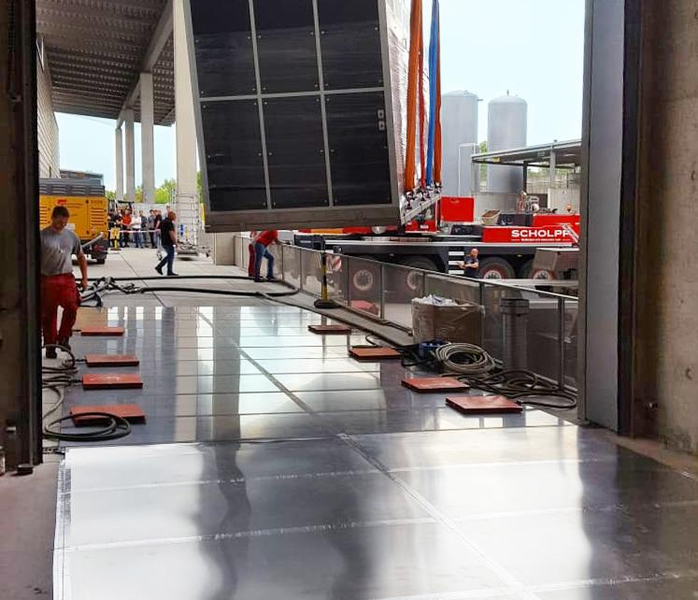
Using our modular air cushions, the machines glide vibration-free to their destination as they are moved into the production area and transported across the production floor. Stainless steel plates, laid without any gaps, serve as the base during transport. Modular air cushion technology offers various advantages over conventional roller or rail-based transport systems:
- Minimized effort: Heavy machinery is easy to move, as an air film creates a virtually frictionless floating state.
- High level of safety: Machines can be raised and lowered without vibration, and rotated and moved smoothly.
- Total precision: Each machine can be positioned with millimetre precision.
- Easy to operate: Air cushion systems can be put into operation quickly and ensure optimum manoeuvrability of heavy loads in confined spaces.
- Moving safely: Moving heavy loads using air cushions is clean, quiet and protective to the floor.
The modular air cushion technology from SCHOLPP can be used in a wide range of industries and production environments:
- Highly sensitive production systems: Semiconductor industry, pharma industry, optoelectronic industry
- Cleanrooms and clean environments: chip fabs, food industry, medical device manufacturing
- Heavy equipment: Energy systems (diesel engines, batteries, transformers) and pocessing equipment (heat exchanger, cooling aggregates)
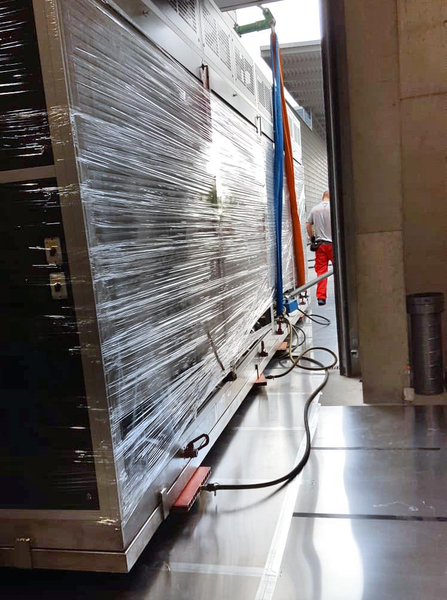
Technology - simply explained
Structure and operation of air-cushion systems
The air cushion systems used by SCHOLPP for machine movements consist of an elastic support cushion and operate using a very thin film of air. Compressed air plays the ‘supporting role’ in lifting and moving heavy loads. The air film minimises friction between the floor and the load to such an extent that a gentle push is sufficient to move and rotate heavy machinery easily in all directions.
Technical principle
- Configuration: To ensure the machine is stable on the air cushion system, the modules are initially positioned well apart beneath the load.
- Balance: The load's centre of gravity must be as close to the centre of the transport system as possible.
- Synchrony: The air-cushion modules are then connected to the control panel.
- Ressources: The compressed air supply should ideally be provided from the in-house network, or alternatively via separate components.
- Air flow rate: The valves on the air cushions are opened and the air pressure is gradually increased until the modules lift the load simultaneously and allow it to ‘float’ gently on the air cushion.
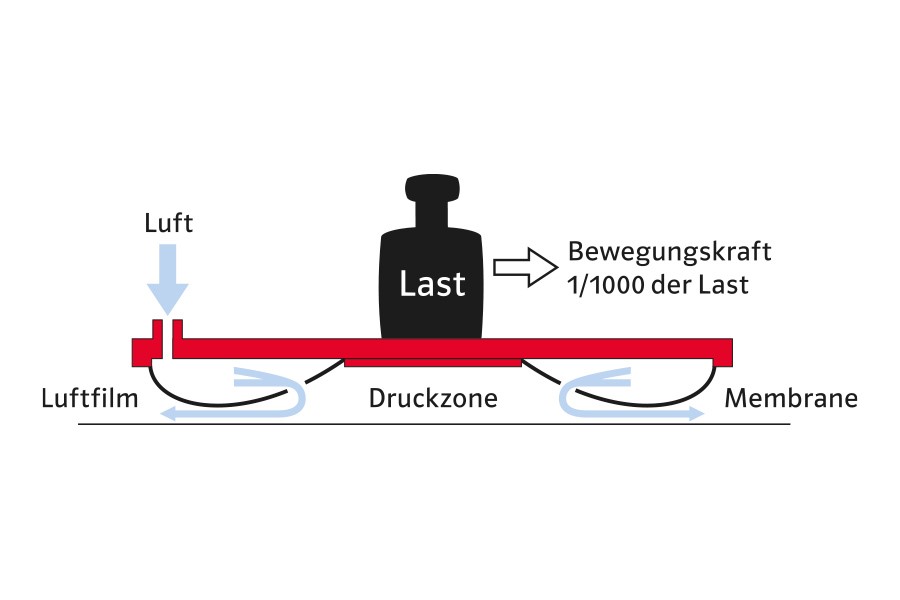
Cross-section of air cushion modules
A constant positive pressure is maintained in the lifting chamber of the air cushion module with load-bearing surface ‘A’. There should be no cracks or holes in the floor through which compressed air could escape unintentionally. As the air film between the air cushion and the floor is very thin, the quality of the floor surface is crucial for the use of air cushion systems. The condition of the subfloor affects air consumption and determines whether positive pressure can build up in the lifting chamber at all.
Optimal ground conditions required
Operating air cushions requires almost perfectly flat surface
The quality and condition of the floors along the transport route are crucial to ensure that a modular air cushion system can be used efficiently for moving heavy loads. Floor surfaces should meet certain requirements to ensure a uniform and stable air film:
- Even surface: The ideal surface for air cushion transport should be flat and without any slope. This prevents air leakage and unintended load shifting.
- No steps: The floor should be level, as any unevenness prevents an even flow of air. Minor unevenness or gaps can be smoothed out or filled in before.
- Air tightness: To ensure that a thin, uniform film of air forms beneath the load without any fluctuations in pressure, the floor should be non-porous and joint-free. Filler material or stainless steel sheets laid without joints provide a solution.
Best practice
Professional equipment for industrial movements: heavy-duty air-cushion systems
![[Translate to English:] Luftkissen für vibrationsfreien Transport im Cleanroom](/fileadmin/_processed_/8/d/csm_Luftkissen_5eae123b42.jpg "[Translate to English:] Luftkissen für vibrationsfreien Transport im Cleanroom")
When move-in conditions are particularly challenging, we transport machinery vibration- and shock-free by air cushion systems.
![[Translate to English:] Reinraum Fahrwerke und Edelstahlplatten für Cleanroom Move In und Rigging](/fileadmin/_processed_/c/5/csm_Fahrwerke_43aa4f87fc.jpg "[Translate to English:] Reinraum Fahrwerke und Edelstahlplatten für Cleanroom Move In und Rigging")
We cover transport routes with stainless steel plates to ensure that our particle-free stainless steel trolleys with antistatic castors can move smoothly.
![[Translate to English:] Einsatz von Luftkissen bei Einbringung von Exponaten ins Mercedes-Museum](/fileadmin/_processed_/9/c/csm_DSC_0052_2c29657333.jpg "[Translate to English:] Einsatz von Luftkissen bei Einbringung von Exponaten ins Mercedes-Museum")
Precise handling of valuable exhibits into museums – gentle, low-vibration and accurate to the millimetre, thanks to heavy-duty air cushion technology.
Best Practice
Tool moving for the semiconductor industry
When project manager Mario König organises a moving project from a chip factory that involves moving sensitive machinery, he often relies on modular air cushion technology. Using a thin film of air, he and his team of fitters move the heaviest of loads into the production buildings with almost no friction.
"We primarily use air cushion transport to move machinery into cleanrooms. We are generally handling highly sensitive equipment and indoor environments that cannot tolerate shocks or contamination. The often tight conditions in semiconductor manufacturing plants further complicate matters", explains Mario König.

60 Tonnes on an air film
It is this high degree of manoeuvrability and lightness that makes air cushions the ideal choice for transporting machinery in specialised industrial environments.
Und ihre Flexibilität, weil die Module, unter die der Luftfilm gepresst wird, genau auf die jeweilige Last angepasst werden können. So lässt sich von Labormaschinen und Lithografiesystemen bis zum 60 Tonnen schweren Aggregat alles sicher und effizient transportieren.
Das erste Mal, dass Mario König mit Luftkissentechnologie in Berührung kam, war 1998: "Damals ging es um den Transport einer sechs Tonnen schweren Anlage zur Belichtung von Waferscheiben in den Reinraum einer Mikroprozessorenfertigung. Ich wurde dafür extra in Holland geschult und war ziemlich beeindruckt von der damals ganz neuen Luftkissentechnik."
In vielen Jahren Berufspraxis ist bei Mario König eine reiche Erfahrung gewachsen. "Was damals neu war, ist heute Standard", meint König, "aber die Bedingungen in Reinräumen sind nach wie vor anspruchsvoll." Unter den "raised floar" genannten Doppelböden verlaufen u.a. Kabeltrassen für Strom sowie Rohrleitungen für Druckluft, Wasser und chemische Flüssigkeiten. "Deshalb müssen wir bei Maschinentransporten auf die Lastverteilung achten. Luftkissentechnik schafft das auf ideale Weise", erläutert König.
Synchronisierte Luftkissentechnik mit festgelegter Choreografie
Auch wenn es im wahrsten Sinne des Wortes federleicht aussieht, was Luftkissen möglich machen, ist das Verschieben und Rotieren von Maschinen mit dem Luftkissensystem absolute Präzisionsarbeit. "Weil wir eben nicht mal einfach bremsen und sofort stoppen können", betont König.
Bremsen heißt hier: Luftfilm abschalten. Aber die Lastmodule senken sich nur allmählich auf den Boden, die Bremswirkung setzt verzögert ein. Im Idealfall müssen die SCHOLPP-Fachmonteure erst gar nicht so bremsen. Denn sie legen vorab jeden Schritt und jede Drehung fest: Wie bei einer Choreografie - nur mit schwerster Last.