
+49 (0)1805 758-599
info(at)scholpp.com
Contact form
![[Translate to English:] Tool Move In Reinraum und Halbleiter in Magedeburg](/fileadmin/_processed_/a/d/csm_Reinraummontage-scholpp_27bfdc8417.jpg)
SCHOLPP white paper: Moving production systems efficiently in the cleanroom
Rigging in the semiconductor industry
What’s special about moving tools in the cleanroom?
Cleanrooms in the semiconductor industry are not just cleanrooms. They are highly specialised environments designed to reduce all types of contamination to a minimum. This is the only way to maintain the high quality requirements for the semiconductor products manufactured in these environments.
But what makes cleanrooms in semiconductor manufacturing so special when it comes to the hook-up? In this white paper, we demonstrate what is required for a successful Cleanroom Move-In® (CMI), i.e. the installation of production equipment in the cleanroom of a semiconductor plant. When it comes to rigging in semiconductor manufacturing, there are many influential factors.
Creating an installation concept
What does a cleanroom move-in solution look like?
In semiconductor manufacturing, a professional move-in solution plays a decisive role in the successful installation of machines in cleanrooms.
- Which installation equipment offers the best solution?
- What are the spatial conditions in the production environment?
- What are the manoeuvring risks on the transport route?
- How is the timing of deliveries coordinated?
The installation concept for machines in semiconductor manufacturing should answer these and many other industry-specific questions. When designing the perfect Cleanroom Move-In® strategy, there is never a standard solution. It always depends on the individual machines, the existing transport routes and the space available in the cleanroom of the semiconductor manufacturing facility.
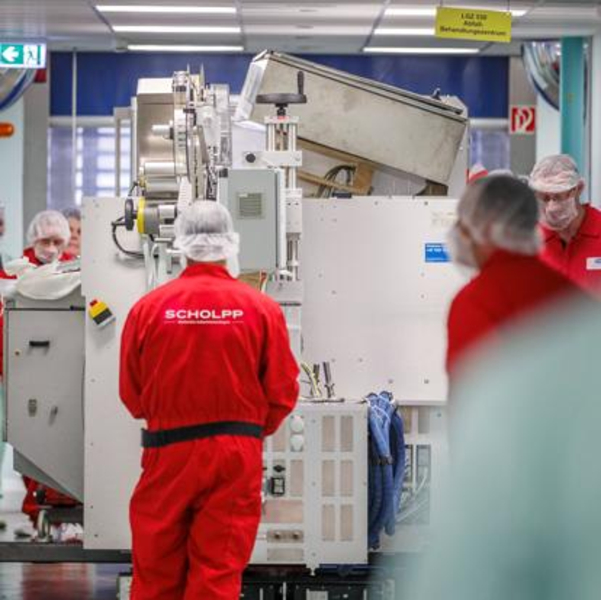

Moving machines in the cleanroom
SCHOLPP white paper: Expertise for the semiconductor industry
This SCHOLPP white paper highlights the challenges and solutions associated with move-in and rigging in semiconductor manufacturing. With over 25 years in the industry, SCHOLPP demonstrates how you can achieve a safe cleanroom tool move-in, by building on a wealth of experience and technical expertise combined with detailed planning and the right equipment.
Best Practice
White paper preview: The three essentials of moving production tools into a cleanroom
Move in concept
An efficient plan ensures that moving in the production equipment is carried out smoothly, safely and cost-effectively. It takes account of the existing spatial conditions and makes the most of them. Various factors play a key role here, such as the weight and design of the machinery, moving parts, available access points, and the designated transport route, including its load-bearing capacity. Only when considering all these aspects risks can be minimised, downtime reduced and efficient operations ensured.
Certified and trained staff
Our experienced and technically trained staff reliably ensure vibration-free and emission-free transport of sensitive production equipment in cleanrooms. All SCHOLPP riggers have many years of experience and are fully trained to work in cleanrooms.
Particel-free clean equipment
SCHOLPP uses modular air cushion technology (with a load capacity of up to 1.5 tonnes per air cushion pad) as well as abrasion-free, antistatic hoists and heavy-duty castors to ensure that the tools are moved in the cleanroom without vibration, impact or emissions.

Request the SCHOLPP tool move-in white paper free of charge!
It only takes three short steps:
- Please enter your contact details so that we can send you the white paper.
- The fields marked with an asterisk* are mandatory. Further optional details help us to better customise the information to your needs.
- Please read and accept our data protection notice.
Any questions?

Qualified personnel
SCHOLPP offers the perfect combination of highly professional staff, staffing continuity, ongoing professional development and a healthy age distribution.

Services as and when needed
We offer you the flexibility to book individual modules as a customised package, or the complete service from planning to commissioning.

Project management
Our high level of organisational expertise and over 60 years of cumulative experience in industrial installation guarantee the successful planning, coordination and implementation of your relocation projects.

Equipment
For every application, the SCHOLPP equipment pool provides the best technology available on the market, in a scope that is unique in Europe and valued at 30 million euros.
Frequently Asked Questions (FAQ)
Since 1998, SCHOLPP has been providing support through its Cleanroom Move-In® service module, a professional tool for hook-up, to internationally renowned companies operating in high-tech environments across all cleanroom classes: technical cleanrooms, cleanrooms and sterile rooms.
A team of experienced specialists and selecting cleanroom-compatible lifting and handling equipment are the crucial factors. Also to the correct use of digital measurement systems to ensure comprehensive monitoring and documentation of all transport movements when relocating production facilities. All SCHOLPP equipment undergoes a strict cleaning and maintenance schedule.
Special cleanroom procedures are kept to ensure that machinery and production equipment are moved in without contamination. These include preparing transport routes with cleanroom-compatible floor coverings (stainless steel), using particle-free transport equipment (castors made of stainless steel or abrasion-resistant plastic), customer-specific cleaning protocols, and the use of cleanroom protective equipment for SCHOLPP riggers. In addition, all work steps are documented and monitored to ensure reliable compliance with cleanroom requirements.
Among others, in cleanrooms ScHOLPP moves lithography systems, wafer inspection equipment, polishing machines, laser systems, etching systems, test systems, vacuum systems and other highly sensitive production systems. During the planning process, SCHOLPP can tailor the necessary transport and lifting equipment to the various machine types, weights and cleanroom classes.
Detailed planning is crucial to the success of a move in project. Even before the production tool is delivered, transport studies, installation plans, risk assessments and schedules are defined. Factors such as space constraints, cleanroom airlocks, transport routes, delivery time slots and the lifting and transport equipment required for the move-in are taken into account. This helps to minimise downtime and ensures that rigging projects are carried out safely and reliably.