
A spectacular operation on the water: Hydraulic cylinders replaced at the Ems barrage
A project with many unknowns: This challenging project saw an eight-person SCHOLPP team from Berlin travel to the Ems barrage at Gandersum, near Emden. It took a year of planning to prepare for the replacement of hydraulic cylinders weighing 32 metric tons. For this complex project, alternative technical solutions had to be considered in order to be prepared for any eventuality. In addition, several specialized companies had to be coordinated, and specific safety standards for working at heights and on the water had to be ensured.
The Ems barrage, operated by the Lower Saxony Water Management, Coastal and Nature Protection Agency (NLWKN), provides reliable protection against storm surges along the Ems River and in the Leda-Jümme region. The barrage’s water-retention function also ensures the flexibility of the Ems waterway between Papenburg and Emden, thereby helping to maintain the region’s economic strength: It can be used to dam the Ems River in order to raise the river’s water level when, for example, new cruise ships set sail from the Meyer shipyard in Papenburg into the North Sea. The rotating and lowering gates of the barrage are moved by massive hydraulic cylinders. Two of them, each weighing 32 metric tons, had to be replaced due to corrosion.
At first, it sounded like a routine maintenance and repair job. However, a closer analysis during the project planning phase revealed that the SCHOLPP team would face several challenges. The client was Van Halteren Technologies, based in Boxtel, the Netherlands. SCHOLPP project manager Karsten Stoppel drove to the scene immediately after receiving the request: “First, I had to take a look at what we were up against. I’ve been working in heavy installation for 40 years, but this kind of project was completely new to me and my team.”
Working between high and low tide: Narrow time windows at slack tide
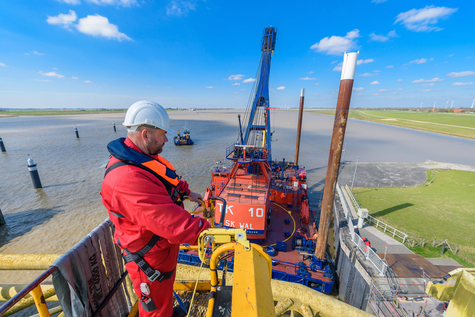
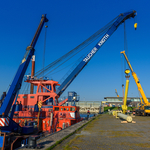
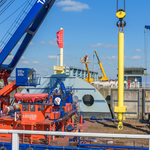
After giving it some thought, Stoppel came to the conclusion that a floating crane would serve as the best working platform. He put together a team of eight experienced installers. A four-week time frame was available. So much time for just two hydraulic cylinders? That seemed more than sufficient. However, during the operation, the tides at the point where the Ems flows into the North Sea had to be taken into account.
Due to the tides, there were only a few short windows of time during those four weeks when the water level was ideal. “We only had 1.5 hours at each slack tide, during which we were able to safely perform lifting operations with the ship’s crane for dismantling and reinstallation,” explains Karsten Stoppel. SCHOLPP safety engineer Hartmut Kleinfeldt, a former naval captain, contributed his expertise to the preparations.
Technical challenges: Feasibility studies and a Plan B
In addition to the dynamic element of water, the cylinders themselves held a few surprises, even during dismantling. Many unknown variables came into play: To what extent had the corrosion of the retaining bolts (600 mm long, 200 mm in diameter) affected the mechanical connection between the gate and the hydraulic cylinder? Would it be possible to remove the bolts using a hydraulic press? How much force can be applied without damaging the structure? To answer these questions, structural engineering reports had to be obtained and technical feasibility solutions had to be developed. For example, special load-distribution plates made of 120-mm-thick iron were designed to prevent damage to the gates’ supporting structure and the barrage’s pillars when the bolts were pressed into place.
Karsten Stoppel recalls that he had a few sleepless nights during the preparations. Would the plans work out? “With the first bolt, we were able to force it out of the hole in the bracket using 200 metric tons of pressure. The second bolt didn’t move a millimeter,” Stoppel reports. What now? He had already factored this possibility into his plans during the one-year planning phase. “That’s when it happened: The worst-case scenario that called the entire project into question. But I’m the kind of person who always has a Plan B up my sleeve. In the installation business, you have to be prepared for anything.”
After extensive discussion, the team decided to go with the solution they had planned all along—drilling out the bolt. To do this, a specialized company was brought in that had the technology to drill through this high-strength, solid specialty steel to a depth of 600 mm. “Six overlapping holes were drilled so that the bolt would collapse in on itself. Then we were able to push it out,” explains Stoppel. Those drilling operations alone took two days. Many drill bits and four drills wore out due to the high stress caused by the hard steel.
Working as part of a team of specialists: Installation know-how, maritime expertise, and high safety standards
All of the retaining bolts were ultimately removed, and the two hydraulic cylinders were dismantled and new ones installed within the project timeline. One key to success was the excellent cooperation with the teams from the other trades. “A project in such a challenging environment cannot succeed without experienced and specialized partners,” Stoppel emphasizes.
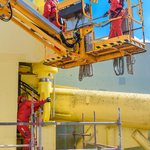
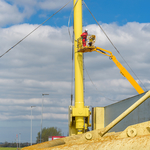
During the installation work at heights of up to 20 meters, strict occupational safety standards also had to be followed. The installers were secured with fall protection to prevent them from falling. During the work, a three-person team of lifeguards in an inflatable boat was also on standby in the water right next to the construction site. “The safety of the team and everyone involved is the top priority,” Stoppel emphasizes.
New assignment on the horizon: Additional cylinders will be replaced
The customer was highly satisfied following the successful completion of the project. The SCHOLPP team will soon be back at the Ems barrage to replace additional hydraulic cylinders. “I’m really proud of my guys for how they nailed this job,” says Karsten Stoppel.
Van Halteren Technologies, Boxtel/Netherl.
Industry:Power plant engineering
Project type:Rigging projects
Task:Replacement of two hydraulic cylinders (32 t) on rotating and lowering gates
Equipment used:Tool container, lifting slings and accessories, iron load-distribution plates (120 mm thick), truck-mounted crane, forklift, lifting platform, special suspended scaffolding, floating crane, high-capacity hydraulic presses (200 metric tons), special drilling machines
Unique factors:Work on the water between low tide and high tide using a floating crane, use of special hydraulic presses and specialized drilling techniques
Contact person:Want to know more about this project? Please contact us.